We’re witnessing the end of the traditional CRM application. And frankly, it’s overdue.
Microsoft’s recent announcement—bringing CRM data into Teams, Outlook, Word, and Excel alongside autonomous agents—isn’t just a feature update. It’s an architectural pivot toward what the industry is calling headless CRM. And if you’re responsible for technology strategy, you need to understand what that means and why it matters.
The monolithic CRM application is dying. The intelligent CRM data layer is what comes next.
What Is Headless CRM?
In e-commerce, “headless commerce” separated the shopping experience (the interface) from the business logic and data layer. The backend could serve products to websites, mobile apps, voice assistants, and kiosks. The experience adapted to where customers were. The data stayed consistent.
Headless CRM does the same thing.
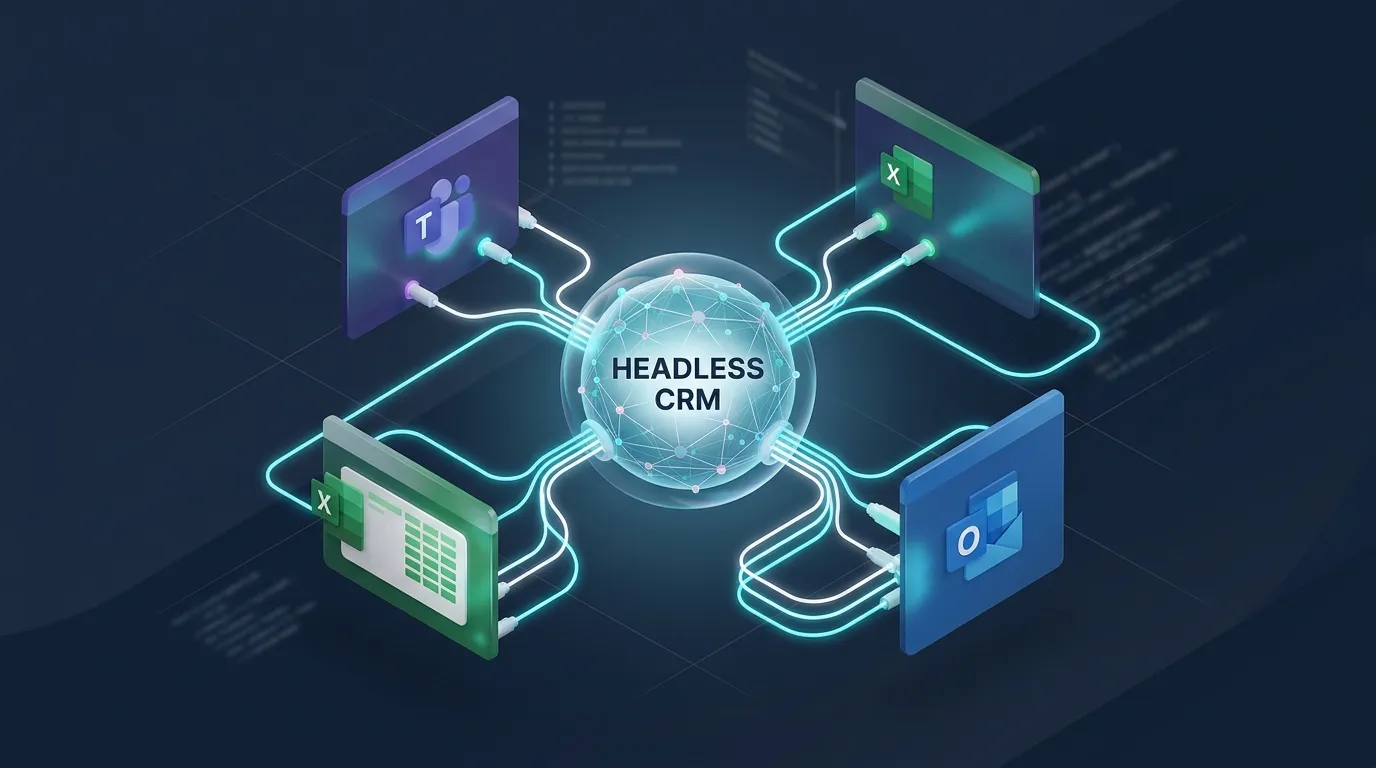
Instead of a monolithic CRM application where you log in, check a dashboard, and manage everything in one place, headless CRM separates the data layer from the presentation layer. CRM data becomes an intelligent service that flows to wherever work actually happens.
Your sales team doesn’t go to CRM. CRM data comes to them—in Teams, in Outlook, in the context of the deal they’re working on. Same for service. Same for operations. Same for finance reviewing customer health.
The “head” (the interface) is distributed across dozens of applications. The “body” (the intelligent data layer with governance, permissions, and AI) remains unified.
This isn’t a new concept. It’s happening across enterprise software. But CRM vendors have resisted it because their entire business model depended on you logging into their application every day.
Microsoft is betting that the future isn’t about logging in. It’s about data and AI working in the background, delivering value wherever you work.
Why Headless CRM Is Inevitable
Three forces make this shift inevitable:
1. Teams Are Already Fragmented
Your organization doesn’t work in one application. Your sales team works in Teams, Outlook, LinkedIn, Excel, and—reluctantly—Dynamics 365 Sales. Your service team works in Teams, Slack, email, and your ticketing system. Your leadership works in Teams, email, and custom dashboards.
The idea that you could centralize all work in one CRM app was never realistic. It was just the best option available at the time.
Headless CRM acknowledges reality: people work where they’re productive. Data should follow them there.
2. AI Requires Distributed Intelligence
Autonomous agents don’t live in your CRM application. They live in your email, your chat, your documents. The Sales Development Agent doesn’t sit in Dynamics 365 waiting for you to ask it something. It proactively identifies promising prospects, personalizes outreach, and manages follow-ups—all from your email system.
The Service Agent doesn’t require you to navigate to a case management system. It understands context from conversations in Teams and Outlook, then creates cases and drafts responses.
AI agents are inherently distributed. They need to be where work happens, not where data is stored. Traditional CRM applications can’t deliver that.
3. Data Quality Demands a Different Architecture
The biggest problem with traditional CRM isn’t the interface. It’s data quality. Your sales team closes deals in email but logs them in CRM days later—or not at all. Your service team solves problems in Slack but enters them as cases afterward. By then, the data is stale and incomplete.
In a headless architecture, data flows automatically from where work happens into your central CRM data layer. A sales email becomes a CRM record instantly. A service conversation in Teams creates a case without manual intervention. Data quality improves because you’re capturing activity where it occurs, not asking people to remember to log it later.
The Architecture Shift
Here’s what’s actually changing:
Old model (monolithic CRM):
- User logs into Dynamics 365 or Salesforce
- User views customer data in dedicated app
- User performs tasks in the CRM interface
- Data sits in the CRM, occasionally synced to other systems
- Teams work around the system because it doesn’t integrate with their workflow
New model (headless CRM):
- User works in Teams, Outlook, email, Word, Excel
- CRM data (customer context, AI insights, case history) appears automatically in context
- User performs tasks in their native workflow
- AI agents handle routine work autonomously
- Data flows bidirectionally: work happening in Office apps updates CRM; CRM insights surface in Office apps
- The CRM becomes invisible—it’s working in the background, not commanding attention
The difference is profound. In the old model, CRM was a separate system. In the new model, CRM is an intelligent layer underlying where work actually happens.
This shift changes everything about how you architect, deploy, and govern customer data systems.
What This Means Strategically
For Technology Leaders
The headless CRM shift means your CRM strategy can’t be “everyone logs into one application.” Your strategy has to be “customer data is the connective tissue across all our tools.”
This has profound implications:
API-first architecture becomes non-negotiable. Your CRM must expose data through APIs, not just through a user interface. You need to integrate with Teams, Outlook, Power BI, custom applications, and services you haven’t built yet. APIs are how that happens. This is why Dataverse and its rich API surface matter more than a beautiful user interface.
Data governance becomes critical. When CRM data is distributed across multiple applications, ensuring consistency and security becomes harder. You need clear data governance, permission models, and audit trails. Headless architecture exposes governance gaps that monolithic apps could hide. If your organization has weak data governance, this shift will force you to fix it.
Integration complexity increases. You’re no longer managing one application. You’re managing a CRM data layer connected to dozens of touchpoints. That’s more complex than traditional CRM. You need better orchestration, monitoring, and governance. But the payoff is significant: your teams work in their native tools, your data quality improves, and AI agents can operate effectively across your business.
Legacy system modernization becomes urgent. If your customer data is scattered across multiple systems or locked in legacy platforms, headless CRM becomes harder to implement. You need unified, clean data. If you don’t have that, you need a modernization program. Tools like Dynamics 365 Activate can help you understand the scope, but the work is non-trivial.
For Sales and Service Leadership
Headless CRM changes what you’re managing and how you measure success.
With autonomous Sales Development and Service agents, you’re no longer managing people doing routine work. You’re managing AI teammates. That means:
Different metrics. You’ll measure agent productivity differently. A Sales Development agent might generate 10x the pipeline activity of a human rep, but it requires different calibration and management. Your KPIs shift from “activities per rep” to “qualified opportunities per agent” and “resolution time per case.”
Different hiring. You’ll hire fewer entry-level reps and more specialists who handle complex deals and escalations. The junior sales development role becomes automated. Your hiring profile becomes: experienced closers and subject matter experts, not trainees learning the job.
Different skill sets. Your team needs to understand AI capabilities and limitations. They need to know when to trust the agent and when to intervene. That’s a different skill than traditional sales development. You’re managing AI, not managing people managing processes.
Competitive differentiation shifts. The team with the best AI agents wins. That means investing in agent training (which is really: tuning AI models and refining prompts), not just hiring and training. Your competitive advantage comes from how well you’ve taught the AI to understand your business, not from hiring better people.
For Finance and Operations
Headless CRM improves visibility dramatically.
Because data flows automatically from where work happens, you finally get accurate, real-time visibility into:
- Deal health (not what reps remember to update, but what’s actually happening in emails)
- Customer satisfaction (from service conversations, not annual surveys)
- Pipeline accuracy (not historical forecasts, but current activity and intent signals)
- Operational efficiency (not assumptions, but measured reality)
- Revenue predictability (because you’re measuring actual activity, not optimistic estimates)
That transparency is powerful. It changes how you forecast, how you allocate resources, and how you manage risk.
The Honest Challenges
Headless CRM isn’t a universal upgrade. It comes with real challenges:
Governance gets harder. When CRM data is distributed across multiple apps, ensuring security and compliance becomes more complex. You need stronger permission models, audit trails, and data lineage tracking. Organizations with weak governance will struggle significantly.
Integration risk increases. More integrations mean more points of failure. If your Outlook integration breaks, users can’t see customer context in email. If your Teams integration fails, your agents can’t operate in chat. You need better monitoring, faster incident response, and clearer escalation paths.
Change management is massive. You’re not just upgrading software. You’re fundamentally changing how people work. Sales reps who’ve built habits around logging into Dynamics 365 need to change their workflow. That’s hard. It requires strong executive sponsorship and clear communication about why.
Legacy systems create friction. If your customer data is scattered across multiple systems, headless CRM becomes harder. You need unified, clean data. If you don’t have that, modernizing your data layer becomes a prerequisite.
Skills gap emerges. Your IT teams need to understand API integration, governance, and monitoring at a level they may not have reached yet. You may need to hire new skills or invest heavily in training.
Why Microsoft Has the Advantage
Microsoft has structural advantages in executing headless CRM:
They own the endpoints where most knowledge workers spend time: Teams, Outlook, Word, Excel, OneDrive. They can deeply integrate CRM data into these apps in ways competitors can’t. Salesforce has to force-fit Einstein AI into their ecosystem. Oracle is building from behind. Microsoft can distribute AI intelligence across Microsoft 365 with native integration.
They also own Dataverse, which gives them clean separation between data and presentation. That’s the architectural foundation headless CRM requires. Salesforce’s data model is tightly coupled to their user interface. Dataverse was built for this kind of distributed consumption.
That doesn’t mean the competition can’t catch up. But it means Microsoft starts with a structural advantage that will be difficult to overcome.
What Organizations Should Do Now
If you’re running Dynamics 365: You’re in a good position. These capabilities layer on top of what you have. Start piloting the new integrations and autonomous agents with real teams. Measure the impact. Build governance and monitoring as you scale. Plan your data governance strategy now, before complexity increases.
If you’re running Salesforce or Oracle CRM: You need to understand that your vendors are moving toward headless models too. But their integration with Microsoft 365 will always be secondary. Consider whether your long-term architecture should be built on a platform that owns your collaboration tools and data layer. Evaluate whether a migration to Dynamics 365 makes strategic sense for your organization.
If you’re evaluating CRM platforms: Ask hard questions about API maturity, Microsoft 365 integration depth, autonomous agent roadmaps, and Dataverse capabilities. The best CRM platform in 2026 isn’t the one with the best user interface. It’s the one with the best integrations, the strongest data layer, and the most capable AI agents.
For all organizations: Start thinking about CRM as a data and intelligence layer, not as an application. How does customer data flow across your organization? Where are the gaps? How will you govern distributed data? What would a 24/7 autonomous agent do with better access to your data? These strategic questions matter more than vendor choice.
The Future
Headless CRM is where we’re heading. In five years, the concept of “logging into your CRM application” will seem antiquated—like how accessing email through a standalone email client seems quaint now.
Your CRM data will be the connective tissue across how your organization works. It will appear in context wherever you’re working. Autonomous agents will manage routine customer interactions continuously. AI will surface insights automatically. Your team will focus on relationships and complex problems that require judgment.
The organizations that embrace this transition early will have significant competitive advantages. Those that cling to traditional monolithic CRM apps will increasingly struggle with adoption, data quality, and operational efficiency.
The shift has started. Microsoft’s announcement is accelerating it. The question isn’t whether headless CRM is coming. It’s how quickly your organization can adapt to it.
Thinking about your long-term CRM strategy? Headless CRM fundamentally changes what you’re optimizing for. We help organizations navigate this transition—from evaluating the right platform architecture to managing the governance and integration complexity. Let’s talk about what this means for your technology roadmap and competitive positioning.